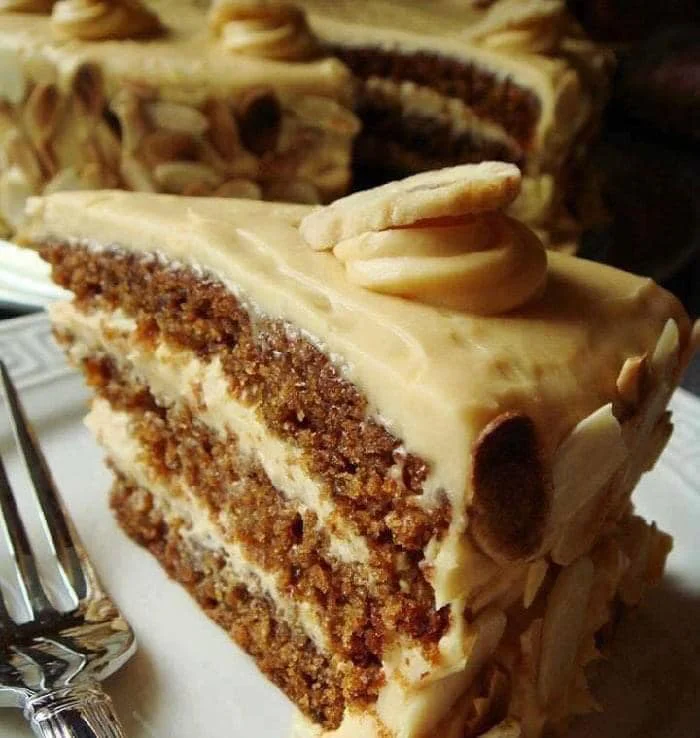
Brown Sugar Butterscotch Cake with Caramel Icing is a simple layer cake built around brown sugar, buttermilk, and a cooked brown-sugar icing. The original version of this page described a salted caramel drizzle and brown-butter frosting, but those ingredients are not actually part of the recipe, so I’m keeping the description aligned with what goes into the cake.
The cake itself is soft and straightforward. The part that needs more attention is the icing because it thickens as it cools. I recommend having the cake layers completely cooled before you start the caramel icing so you can spread it while it is still warm and workable.
What Gives This Cake Its Butterscotch Flavor
There are no butterscotch chips in this recipe. The flavor comes from brown sugar and butter. Brown sugar brings a deeper molasses note than white sugar, while buttermilk adds a slight tang that keeps the cake from tasting one-dimensional.
The cooked icing doubles down on that brown-sugar flavor. It is thinner than a fluffy buttercream and firms as it cools, creating a smooth caramel-like coating over the cake.
Cake Ingredients
- 2 cups brown sugar
- 1/2 cup butter
- 1 teaspoon vanilla extract
- 2 eggs
- 2 cups all-purpose flour
- 1 teaspoon baking soda
- 1 teaspoon baking powder
- 1/2 teaspoon salt
- 1 cup buttermilk
How to Make the Cake Layers
- Preheat the oven to 350°F.
- Grease and flour two 9-inch round cake pans or three 6-inch round pans. You can also line the bottoms with parchment for easier release.
- Cream the butter and brown sugar with an electric mixer on medium speed until lighter and fluffy.
- Add the vanilla.
- Add the eggs one at a time, mixing on low just until each egg disappears into the batter.
- In a separate bowl, whisk or sift together the flour, baking soda, baking powder, and salt.
- Add the dry ingredients and buttermilk to the butter mixture in alternating additions, starting and ending with the flour mixture.
- Mix on low only until the batter is combined, then scrape the bowl by hand so no dry pockets remain.
- Divide the batter evenly among the prepared pans.
- Bake for 25 to 30 minutes, or until the centers are set and a toothpick inserted near the middle comes out without wet batter.
- Cool the layers completely before making the icing.
Why Alternating the Flour and Buttermilk Helps
Adding all of the flour or all of the buttermilk at once can make it harder to mix the batter evenly without overworking it. Alternating them keeps the batter easier to blend and helps us stop mixing as soon as everything is incorporated.
My rule here is simple: once the flour starts going in, use the mixer only as much as necessary. A few final turns with a spatula are better than several extra minutes of beating.
Caramel Icing Ingredients
- 1 1/2 cups brown sugar
- 1 tablespoon all-purpose flour
- 1/4 cup butter
- 1/4 cup milk
- 1 teaspoon vanilla extract
- 2 additional tablespoons butter, added after cooking
How to Make the Cooked Caramel Icing
- In a small saucepan, combine the brown sugar, flour, 1/4 cup butter, and milk.
- Cook over medium heat, stirring frequently, until the mixture comes to a boil.
- Boil for a full minute while stirring so the mixture does not scorch. The original recipe also gives 238°F as the thermometer target if you prefer measuring the sugar stage.
- Remove the saucepan from the heat.
- Stir in the vanilla and the remaining 2 tablespoons butter.
- Let the icing cool, stirring it vigorously from time to time, until it is still warm but noticeably thicker.
- Spread it over the cooled cake while it is still fluid enough to work with.
- Let the icing set completely before slicing.
The Icing Changes Quickly
This is not a buttercream you can leave on the counter and return to much later. As the cooked sugar mixture cools, it becomes thicker and eventually starts setting. I recommend watching the texture instead of walking away from the pan.
If it is still very hot and runny, give it more time. If it becomes difficult to spread, it has cooled too far. The ideal point is warm, thickened, and still able to flow across the cake in a thin coating.
Common Mistakes to Avoid
Frosting warm cake layers: The cake must be fully cool or the cooked icing can slide and soak into the surface unevenly.
Letting the icing cool completely in the pan: It is designed to set. Spread it while it is still warm enough to move.
Overmixing the cake batter: Once the flour and buttermilk are being added, mix gently and stop as soon as the batter is smooth.
Using the wrong expectation for the icing: This recipe makes a relatively thin cooked coating, not a thick piped frosting.
Make-Ahead and Storage
You can bake the cake layers ahead and wrap them once completely cooled. I would make the caramel icing closer to assembly because its spreadable window is part of the recipe.
Store the finished cake covered so the cut edges do not dry out. For the cleanest slices, let the icing set fully before cutting.
For more layer cakes and old-fashioned desserts, browse our dessert recipes.
